AAWDF — AI Agent Workflow Design Framework
The AAWD framework makes AI agent system design structurally precise. It replaces fragmented pattern catalogs with a layered architecture that shows where decisions must be made, how they depend on each other, and how complete systems are specified without ambiguity.
It guides practitioners to distinguish enduring architectural constructs—capability surfaces, control loci, cognition loops, coordination topologies, and governance boundaries—from the growing set of overlapping and often redundant agent “patterns.”
Together, the deployment envelope and execution layers form a complete specification model through which any AI agent system can be designed, analyzed, and stress-tested.
AAWDS is designed for engineers, architects, and researchers building production-grade agent systems across domains such as enterprise automation, decision-support systems, multi-agent orchestration, and autonomous workflows.
With explicit structural decomposition, the framework enables:
-
Clear separation between primitives and compositions
-
Removal of synonym inflation across agent design patterns
-
Predictable mapping of system behavior to architectural choices
-
Identification of failure modes at the correct layer
The framework is built around a strict architectural dichotomy:
-
Deployment Envelope — defines when systems execute and how they evolve over time
-
Execution Stack (L1–L5) — defines how systems operate within each run
This separation ensures that temporal concerns (trigger, adaptation) are not conflated with execution logic, which is a common failure in existing agent taxonomies.
The structure focuses on what current agent design approaches lack:
-
A complete specification model (not just pattern lists)
-
Explicit dependency ordering between design decisions
-
A consistent mapping between architecture and behavior
-
A method to compress and reconcile overlapping patterns
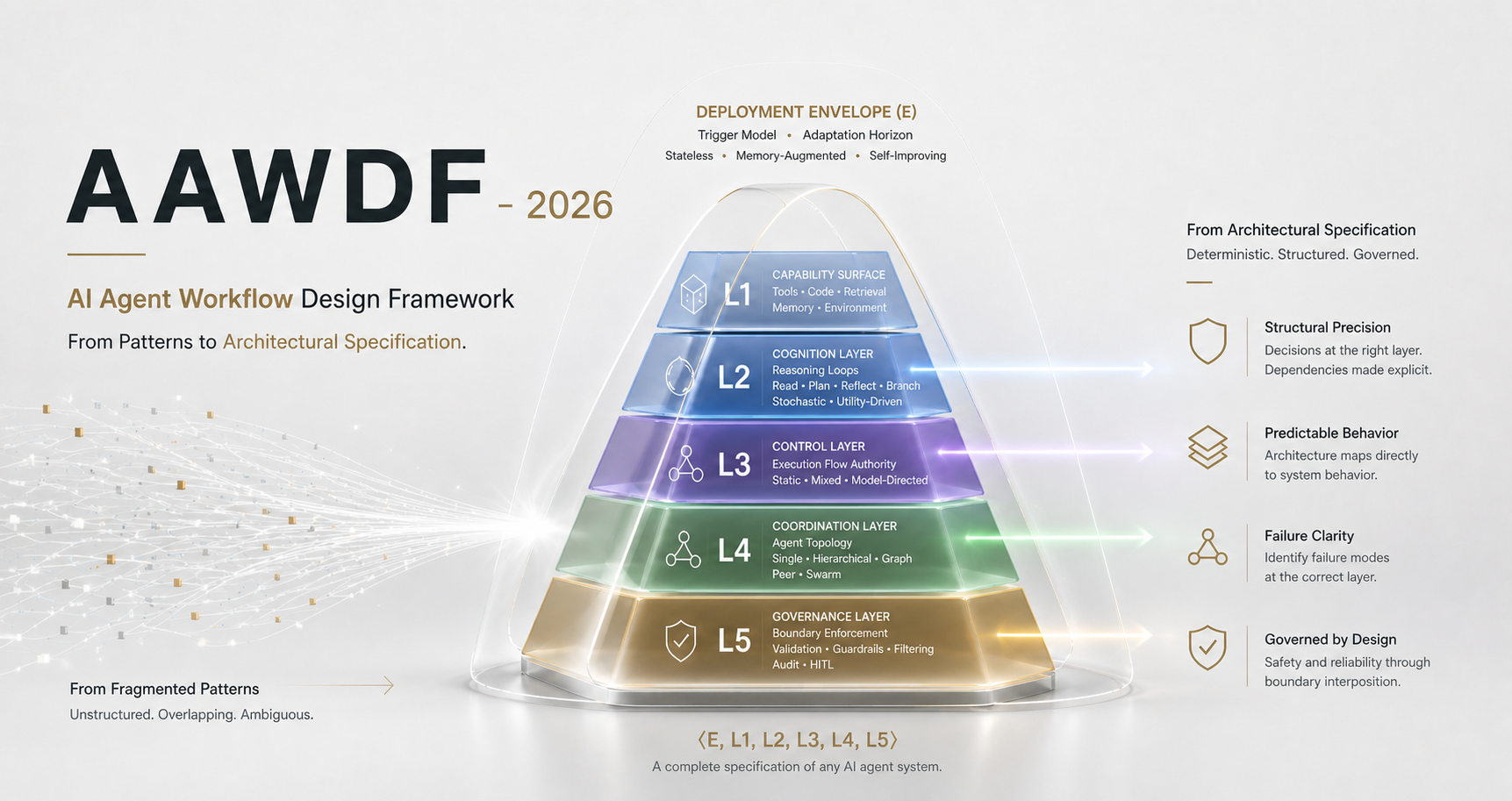
AAWDS is organized into a layered system:
-
L1 — Capability Surface
Defines the action and observation space (tools, code, retrieval, memory, environment) -
L2 — Cognition Layer
Defines the reasoning loop (ReAct, plan-first, reflective, branching, stochastic, utility-driven) -
L3 — Control Layer
Defines who determines execution flow (static, mixed, model-directed) -
L4 — Coordination Layer
Defines agent cardinality and topology (single-agent, hierarchical, graph, peer, swarm) -
L5 — Governance Layer
Defines boundary enforcement (input validation, tool guardrails, output filtering, audit, HITL) -
Envelope (E)
Defines trigger model and adaptation horizon (stateless, memory-augmented, self-improving)
Each layer is not descriptive—it is deterministic. A system is fully specified as a tuple:
⟨E, L1, L2, L3, L4, L5⟩
This transforms agent design from pattern selection to architectural specification.
AAWDS does not discard existing agent patterns. It relocates them:
-
Some are primitive layer choices (e.g., ReAct → L2)
-
Some are control configurations (e.g., orchestrator-workers → L3 + L4)
-
Some are compositions across layers (e.g., Reflexion → L2 + adaptation)
-
Some are capability augmentations (e.g., RAG → L1)
The result is a compression of the agent design space into a minimal, non-overlapping structure.
The framework introduces a critical design shift:
Governance is not an overlay. It is boundary interposition between layers.
This allows control, safety, and reliability to be enforced at precise execution points rather than as post-hoc constraints.
AAWDS is not a catalog.
It is a structural model for reasoning about agent systems.